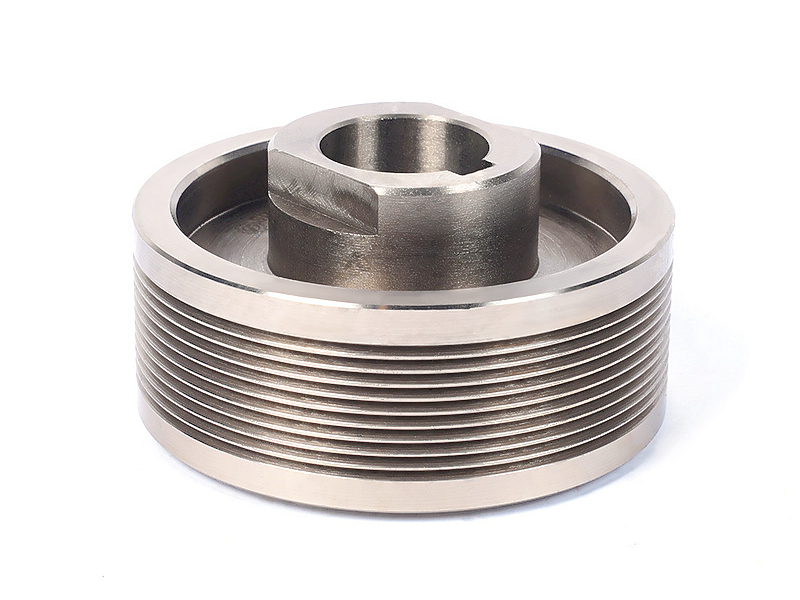
Through years of precision manufacturing practice at Neway, we have come to firmly recognize one core truth: to produce truly high-performance titanium alloy components, you must first deeply understand the material’s intrinsic properties. These properties not only define the ultimate performance limits of a part, but also directly guide the planning of the entire machining process route. As an engineering team that has specialized in titanium CNC machining services for many years, we have seen numerous cases where insufficient understanding of material behavior led to components failing to meet performance expectations.
Titanium alloys have become the material of choice in high-end fields such as aerospace and medical devices precisely because of their unique combination of properties. However, these advantages also bring distinct machining challenges. Only by fully understanding the scientific principles behind these characteristics can we utilize precision machining processes to unlock their full potential and manufacture truly high-performance parts that withstand real-world demands.
The most striking feature of titanium alloys is their exceptional strength-to-weight ratio. For example, the widely used Ti-6Al-4V (TC4) offers strength comparable to certain alloy steels while being approximately 40% lighter. This makes it a key material for lightweighting in aerospace applications, but it also imposes specific requirements on machining processes.
During machining, the high strength of titanium alloys demands higher cutting forces, which means machine tools must provide sufficient rigidity and cutting tools must deliver excellent wear resistance. In our CNC milling services, we have observed that cutting forces for titanium alloys can be approximately 50% higher than those for aluminum, necessitating corresponding adjustments in process parameters and fixturing design. This is especially critical for thin-walled structures, where high cutting forces can easily cause deformation; we address this through optimized toolpaths and specialized support strategies.
Titanium alloys have very low thermal conductivity—around 1/16 that of pure aluminum—so heat generated during machining cannot be quickly dissipated. In our CNC turning services, we have observed that nearly 80% of the cutting heat accumulates on the tool rake face, causing rapid temperature rise and accelerated tool wear. More critically, localized overheating may alter the surface microstructure, forming an embrittled “alpha case” layer that severely degrades fatigue performance.
To address this challenge, we have developed dedicated cooling strategies. When machining Ti-6Al-4V ELI (Grade 23) medical implants, we utilize high-pressure through-tool coolant systems at 70–100 bar, ensuring that the coolant penetrates the chip barrier and reaches the tool–chip interface. At the same time, we optimize cutting parameters by using relatively low cutting speeds and moderate feeds to effectively control temperature while maintaining productivity.
Titanium alloys exhibit a notable tendency toward work hardening during machining, driven by their relatively high strain hardening index and low thermal conductivity. In our precision machining services, we frequently encounter the following phenomenon: if a worn tool repeatedly cuts over an already machined surface, tool life drops sharply because that surface has hardened by approximately 20–30%.
We use multiple strategies to control work hardening. First, we always ensure sharp cutting edges, avoiding the use of worn tools that “rub” rather than cut the hardened layer. Second, we apply sufficient depth of cut so that each pass engages below the work-hardened zone. When machining Beta C titanium alloy, precise process control allows us to limit the hardened layer depth to within 0.1 mm, preserving the component’s fatigue performance.
At elevated temperatures, titanium alloys exhibit high chemical reactivity—especially above 500°C, where they tend to react with most tool materials, resulting in diffusion and adhesive wear. This behavior is particularly pronounced in our multi-axis machining services, where complex toolpaths cause fluctuating tool temperatures.
We address this challenge by selecting suitable tool coatings. AlTiN and TiAlN coatings, with their excellent thermal stability and lower thermal conductivity, are our primary choices. They form a protective barrier that reduces direct contact between the titanium and the tool substrate. When machining high-strength structural parts made of Ti-10V-2Fe-3Al (Grade 19), we also pay close attention to coolant chemistry, choosing chlorine-free cutting fluids to prevent stress corrosion cracking.
Titanium alloys naturally form a thin, dense, and stable oxide film (primarily TiO₂) on their surface. Just a few nanometers thick, this film provides outstanding corrosion resistance. In medical device manufacturing, this property, combined with excellent biocompatibility, makes titanium alloys the ideal choice for implants. However, during machining, we must take care to preserve and enhance this protective layer.
We use passivation treatments to rebuild and strengthen this oxide film. When machining TA15 titanium alloy aerospace components, we strictly control process temperatures to avoid excessive oxide growth or composition changes. For more demanding applications, we also offer micro-arc oxidation services to generate thicker, more wear-resistant ceramic coatings.
Titanium alloys have a relatively low elastic modulus—about half that of steel—which makes them more prone to elastic deflection during machining. In CNC grinding services for thin-walled parts, this “springing away from the tool” effect is particularly evident and directly impacts dimensional accuracy. We counter this with optimized fixturing and staged machining strategies.
When machining Ti-5Al-2.5Sn (Grade 6) compressor blades, for example, we use contour-supporting fixtures to stabilize the part during machining. We also employ finite element analysis to predict stress distribution and then plan the machining sequence accordingly—processing the more rigid regions first and the thin-walled areas later—to minimize deformation. In our 5-axis machining services, we further optimize tool orientations to ensure that cutting forces are directed along the stiffer directions of the setup.
At Neway, we have developed a comprehensive titanium machining methodology that tightly integrates material properties with process design. From the very beginning—material selection—we consider the component’s final application environment. For aerospace structural parts with extremely high reliability requirements, we may recommend commercially pure Grade 2 titanium, whose excellent formability and weldability are advantageous for complex structures.
During process development, we combine EDM services with conventional cutting to handle challenging geometries. Especially in our low-volume manufacturing services, this flexible approach enables rapid response to customized requirements while maintaining quality and consistency.
Our one-stop service system ensures strict control at every stage from material to finished product. In mass production services, standardized workflows and continuous process monitoring guarantee that every part meets the same high standard of quality. Whether in aerospace or the automotive sector, we provide reliable titanium machining solutions backed by professional expertise and rigorous process control.
For components operating in harsh chemical environments, such as those used in chemical processing equipment, we pay special attention to preserving titanium’s inherent corrosion resistance. Through optimized machining processes and appropriate surface treatments, we ensure stable long-term performance under demanding conditions.
What are the main differences between TC4 (Ti-6Al-4V) and TC4 ELI in terms of performance and machinability?
What is the most effective cooling method for addressing the low thermal conductivity of titanium alloys?
How can chip appearance be used to determine whether titanium machining conditions are optimal?
Which types of tool coatings are best suited for machining titanium alloys?
For titanium components requiring high fatigue strength, what special considerations should be taken during machining?