日本語

Ultrasonic Testing Solutions for Internal Defects in CNC Machined Parts

目次
Introduction: Why Do CNC-Machined Parts Require Internal Defect Inspection?
Ultrasonic Testing (UT) Technology Explained: Principles and Advantages
How Does Ultrasonic Testing Work?
What Are the Unique Advantages of UT Compared with X-ray and Magnetic Particle Inspection?
Common Types of Internal Defects in CNC Machined Components
Shrinkage Porosity and Looseness
Internal Cracks and Non-metallic Inclusions
Lack of Fusion and Porosity
Neway’s Ultrasonic Testing Solutions and Service Process
Step One: Pre-inspection Consultation and Customized Plan
Step Two: Surface Preparation and Coupling
Step Three: Advanced UT Equipment Scanning and Data Acquisition
Step Four: Data Analysis and Professional Report Issuance
Applications of Ultrasonic Testing in Critical Industries
Aerospace: Engine Blades and Landing Gear Components
Medical: Implants and Surgical Instruments
Energy: Turbine Rotors and Pressure-Bearing Components
Key Advantages of Choosing Neway for Ultrasonic Testing
FAQ

Introduction: Why Do CNC-Machined Parts Require Internal Defect Inspection?

In precision manufacturing, part quality depends not only on dimensional accuracy and surface finish, but more importantly on the integrity of the internal structure. As engineers at Neway, we frequently observe in daily quality control that even visually flawless CNC-machined parts may contain various potential internal defects. These hidden flaws are like time bombs that may lead to catastrophic failures once the parts are put into service.

The demand for reliability of components in modern industry continues to rise, especially in critical sectors such as aerospace, medical devices, and energy equipment. Even a tiny internal pore or crack can result in total system failure. Therefore, it is essential to apply effective non-destructive testing methods to perform a comprehensive “health check” on parts. Among the many testing technologies, ultrasonic testing has become our preferred method for detecting internal defects due to its unique advantages.

Ultrasonic Testing (UT) Technology Explained: Principles and Advantages

How Does Ultrasonic Testing Work?

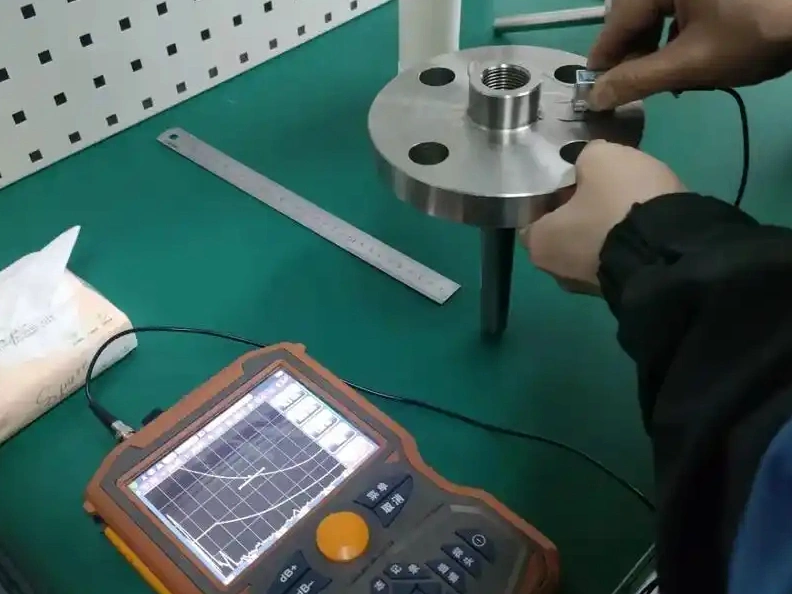
The basic principle of ultrasonic testing is based on the propagation behavior of high-frequency sound waves in materials. When ultrasonic waves travel through a homogeneous material, they maintain their direction and energy. Once they encounter a defective interface, part of the sound energy is reflected. By analyzing these reflected signals, we can accurately determine the location, size, and nature of internal defects.

In our laboratory, the ultrasonic testing system mainly consists of an ultrasonic probe, pulse generator, receiver, and signal display unit. The probe acts as both transmitter and receiver of sound waves and is coupled to the part surface using a coupling agent to ensure proper acoustic transmission. After entering the part, sound waves propagate internally and generate echoes when encountering different media interfaces. These echoes are amplified, processed, and displayed as waveforms on the screen. Experienced technicians interpret these waveform characteristics to accurately evaluate the internal quality of the part.

What Are the Unique Advantages of UT Compared with X-ray and Magnetic Particle Inspection?

Compared with other non-destructive testing methods, ultrasonic testing offers irreplaceable advantages. First is its excellent penetration capability: UT can detect internal defects in large forgings and thick-walled components, where X-ray techniques may be limited. Second, ultrasonic testing is particularly sensitive to planar defects and can reliably identify critical discontinuities such as cracks and lack of fusion oriented perpendicular to the sound beam.

In terms of sensitivity, UT can detect much smaller defects and, in theory, can identify indications with an equivalent diameter as small as half the wavelength. Moreover, ultrasonic equipment is relatively portable, cost-effective, and does not generate radiation hazards. These features make UT an indispensable part of our precision machining services quality assurance system.

Common Types of Internal Defects in CNC Machined Components

Shrinkage Porosity and Looseness

These defects are primarily found in castings and certain types of forgings. During superalloy machining, shrinkage porosity and looseness may form due to volumetric contraction during solidification. Such defects significantly reduce mechanical properties and are prone to act as initiation sites for fatigue cracks under cyclic loading.

Internal Cracks and Non-metallic Inclusions

Internal cracks may originate from metallurgical defects in the raw material or be induced during multi-axis machining due to the release of residual stress. Non-metallic inclusions, such as oxides and sulfides, are introduced during the steelmaking process. In titanium alloy machining and stainless steel machining, these inclusions can severely compromise corrosion resistance and fatigue strength.

Lack of Fusion and Porosity

In additively manufactured and welded components, lack of fusion is a common process defect. During prototype manufacturing and low-volume production, porosity may form due to the presence of gas in materials or improper process parameters. These defects reduce the effective load-bearing cross-section and cause stress concentration in service.

Neway’s Ultrasonic Testing Solutions and Service Process

Step One: Pre-inspection Consultation and Customized Plan

Our service begins with an in-depth assessment of customer requirements. Our engineering team thoroughly evaluates service conditions, acceptance criteria, and potential defect types for the parts, and based on this information, designs a customized inspection plan. At this stage, we place particular emphasis on communication with customers to ensure the solution is both cost-effective and technically robust.

Step Two: Surface Preparation and Coupling

Before inspection, appropriate surface preparation is required, typically achieving a surface roughness of Ra ≤ 6.3μm. We use specialized coupling agents to eliminate air gaps between the probe and the part surface, ensuring effective sound transmission. For parts with special geometries, we design dedicated probe fixtures to maintain scanning stability.

Step Three: Advanced UT Equipment Scanning and Data Acquisition

Neway utilizes advanced phased array ultrasonic testing systems, equipped with probes of various frequencies, to accommodate different materials and inspection requirements. During testing, technicians follow predefined scanning paths to ensure full coverage, while all data is recorded in real time for subsequent analysis.

Step Four: Data Analysis and Professional Report Issuance

After data acquisition, our personnel, certified at Level II and above, perform a detailed evaluation. Based on relevant standards, they characterize, quantify, and locate detected discontinuities, and issue a formal report that includes results, defect indication diagrams, and engineering recommendations. All inspection data and reports are archived to ensure complete quality traceability.

Applications of Ultrasonic Testing in Critical Industries

Aerospace: Engine Blades and Landing Gear Components

In the aerospace sector, we provide ultrasonic inspection services for turbine blades and critical landing gear components. These parts are often made from high-temperature alloys such as Inconel 718, and their internal integrity is directly linked to flight safety. Our dedicated inspection procedures reliably detect even the smallest internal defects, providing strong quality assurance for our customers.

Medical: Implants and Surgical Instruments

For medical device manufacturers, we inspect components such as orthopedic implants and precision surgical instruments. Many of these parts are made from biocompatible materials such as Ti-6Al-4V, where any dangerous internal defects are unacceptable. Our inspection services help customers comply with the stringent regulatory requirements of the medical device industry.

Energy: Turbine Rotors and Pressure-Bearing Components

In the power generation industry, we provide ultrasonic testing for turbine generator rotors and various pressure-bearing components. These parts operate under high temperature and high pressure, where internal defects may cause severe accidents. Our inspection solutions identify potential risks in a timely manner, ensuring the safe and stable operation of the equipment. Similarly, in the oil and gas sector, inspection of critical components such as valve bodies and manifolds is also one of our strengths.

Key Advantages of Choosing Neway for Ultrasonic Testing

At Neway, we consider ultrasonic testing a vital component of our comprehensive one-stop manufacturing service. Our strengths lie not only in advanced equipment and certified personnel, but also in our in-depth understanding of manufacturing processes. As a professional manufacturing company, we clearly understand the mechanisms and risks associated with various defects and can provide customers with technically meaningful evaluations and recommendations.

Our inspection team holds international certifications, including ASNT and EN473, and our procedures encompass the entire process, from raw material verification to final product inspection. For heat-treated parts, we pay special attention to microcracks that may be introduced during the heat treatment process. For parts that have undergone deburring processes, we ensure surface conditions do not interfere with inspection accuracy.

In terms of materials, we are familiar with the acoustic characteristics of a wide range of metals, from conventional stainless steel SUS304 to various special alloys, and we optimize testing parameters accordingly. This capability to tailor inspection techniques based on material properties enables us to deliver the most accurate and reliable inspection results for our customers.

FAQ

  1. How small can internal defects be for ultrasonic testing to detect them?

  2. Will ultrasonic testing cause any damage to my CNC parts?

  3. Is ultrasonic testing applicable to all materials, such as plastics and ceramics?

  4. How long does it typically take to complete an ultrasonic inspection?

  5. Which international standards do Neway’s ultrasonic testing services comply with?

専門家による設計と製造のヒントをメールで受け取りたい方は購読してください。
この投稿を共有:
Copyright © 2025 Machining Precision Works Ltd.All Rights Reserved.