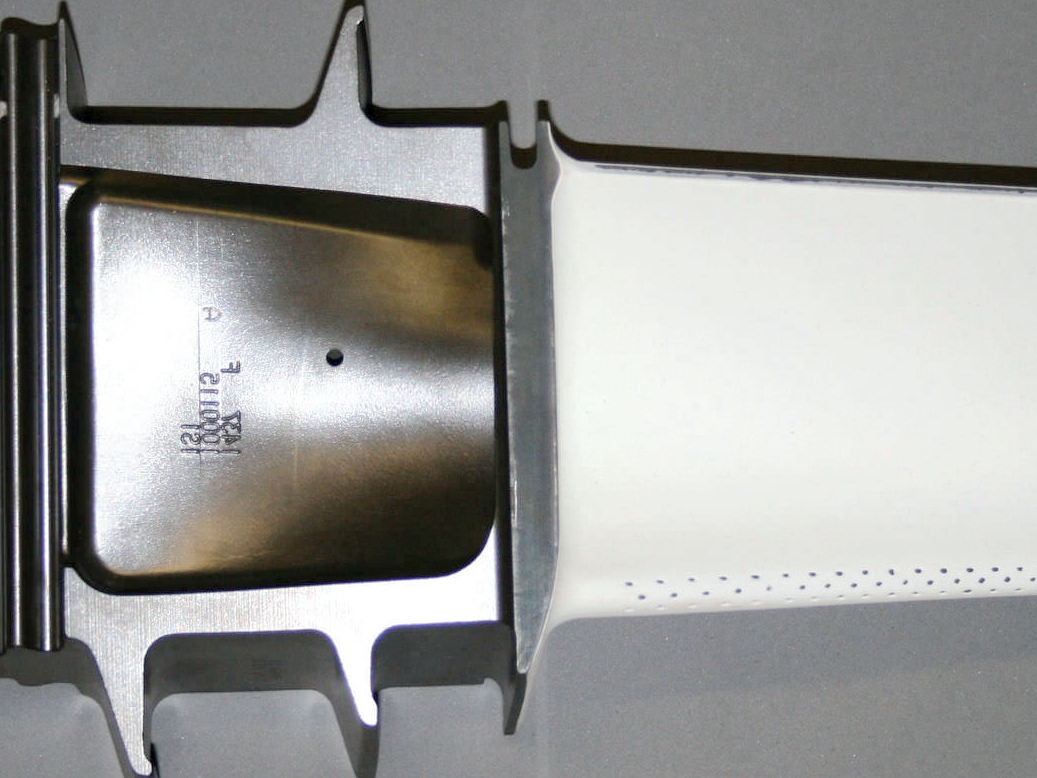
As turbine inlet temperatures, combustion loads, and efficiency targets continue to climb, base alloys alone can no longer guarantee safe and economical operation. Thermal Barrier Coatings (TBCs) have become a core technology for pushing high-temperature components beyond their conventional limits. By applying engineered ceramic coating systems to superalloy and other heat-resistant substrates, TBCs can reduce metal temperatures by approximately 100–300°C under proper design and operating conditions—directly extending component life, improving reliability, and enabling higher thermal efficiency.
At Neway, our thermal coating services are built around this mission: integrating precision machining, advanced coatings, and strict process control to deliver robust, application-specific TBC solutions for aerospace, power generation, oil & gas, and demanding industrial environments.
TBCs rely on ceramic topcoats with very low thermal conductivity (typically 1–3 W/m·K), acting as a thermal shield between hot gas streams and the metallic substrate. Under proper design (material, thickness, porosity, microstructure), this barrier:
Lowers substrate temperature significantly,
Reduces thermal gradients and thermal fatigue,
Enables higher gas path temperatures without requiring a redesign of the base alloy.
Neway tailors coating thickness and architecture to each application, balancing insulation, strain tolerance, and stress distribution rather than simply “making the layer thicker”.
Beyond insulation, a well-designed TBC system also mitigates:
High-temperature oxidation of nickel and cobalt-based alloys,
Attack from corrosive species such as sulfates, vanadates, or contaminants in fuel and air,
Microstructural degradation that would otherwise shorten service life.
For critical superalloy components, this chemical protection is often as important as the thermal function.
The outer ceramic layer is typically based on yttria-stabilized zirconia (YSZ), designed for:
Low thermal conductivity,
Phase stability under operating temperature,
Thermal expansion compatibility with underlying layers,
Porosity and microcracking provide strain tolerance and thermal shock resistance.
Between ceramic and metal lies a metallic bond coat, often MCrAlY (M = Ni, Co, or Ni/Co):
Provides strong adhesion for the ceramic topcoat,
Forms a stable Al2O3 thermally grown oxide (TGO) layer,
Acts as a chemical and oxidation barrier protecting the base alloy.
Neway customizes bond coat chemistry for alloys such as Inconel 625, Hastelloy X, Rene 41, ensuring compatibility and long-term stability.
Atmospheric Plasma Spraying is one of the most widely used TBC deposition methods. Powder feedstock is melted or semi-melted in a plasma jet and propelled onto the prepared substrate. At Neway, robot-controlled APS systems enable:
Uniform coating thickness over complex geometries,
Fine-tuned porosity and lamellar microstructure,
Repeatable quality for single parts and mass production.
Gas turbine blades and vanes, combustor components, transition pieces,
Industrial burner and furnace components, hot-gas ducts.
APS coatings are designed with controlled porosity and microcracks to deliver both good insulation and high strain tolerance under cyclic thermal loads.
EB-PVD, performed in high vacuum, uses an electron beam to evaporate ceramic material, which then condenses on the component surface to form a columnar-grain coating. This structure:
Absorbs thermal strain extremely well,
Provides outstanding thermal shock resistance,
Delivers smooth gas-washed surfaces, ideal for aero-engine aerodynamics.
EB-PVD TBCs are widely used on single-crystal turbine blades and vanes in aerospace engines, where durability, weight, cooling efficiency, and aerodynamic performance are all critical to mission success. Neway’s EB-PVD capabilities are aligned with stringent aerospace quality and traceability requirements.
7–8 wt% YSZ remains the industry workhorse thanks to:
Low thermal conductivity,
Good phase stability in service temperature ranges,
Compatible thermal expansion with Ni-based superalloys.
To support higher turbine inlet temperatures and longer lifetimes, Neway collaborates with research partners on rare-earth zirconates and other advanced ceramics that feature even lower conductivity and improved high-temperature phase stability, targeting next-generation aerospace and power generation platforms.
Our inspection toolbox includes:
Ultrasonic or eddy-current thickness measurements, plus metallographic cross-sections,
Adhesion/bond strength tests (typical requirements ≥ 30 MPa, application-specific),
Microstructure evaluation: lamellae, porosity, TGO growth, columnar morphology (EB-PVD).
We perform thermal cycling and thermal shock tests under representative conditions, including peak temperature, dwell time, ramp rates, and cooling methods, which are matched to the actual duty cycle. These tests reveal primary failure modes such as:
TGO growth and cracking,
Topcoat spallation,
Interface degradation.
TBCs are applied to:
Turbine blades and vanes,
Combustor liners, transition ducts, shrouds,
Nozzles and aftertreatment hot parts.
For components in Inconel 718 and similar alloys, Neway provides integrated machining + coating solutions that meet aviation-grade standards.
In stationary gas turbines and high-temperature process equipment, TBCs:
Increase turbine efficiency,
Extend inspection intervals,
Protect critical hot gas parts in chemical, metallurgical, and thermal processing equipment.
We evaluate:
Alloy composition and prior heat treatment,
Operating temperature window and duty cycle,
Oxidation/hot corrosion resistance of substrate and bond coat system.
Coating design is tuned for:
Peak and cyclic temperature,
Gas composition (fuel impurities, corrosive species),
Mechanical loads, vibration, erosion, and FOD risk.
For oil & gas and nuclear applications, we incorporate additional constraints such as radiation stability and specific corrosion mechanisms.
Neway offers a full-stack approach:
Precision CNC machining of superalloys, titanium, heat-resistant steels,
Engineered surface preparation: blasting, masking, cleanliness, and roughness control,
Metallurgical testing, dimensional inspection, and lifetime evaluation,
A robust mass production framework with full traceability to support aerospace, energy, and industrial OEM programs.
This one-stop model shortens lead times, reduces technical risk, and ensures that coating performance is engineered into the part from the design stage—not added at the end.
In a typical turbine or combustor application, how much can a properly designed TBC reduce the metal temperature?
What is the expected service life of a TBC under real engine or gas turbine operating conditions?
What are the main TBC failure modes (e.g. spallation, TGO growth, erosion) and how can they be minimized through design and process control?
What surface preparation steps (cleaning, roughening, masking) are required before applying a high-reliability TBC system?
Can worn or partially failed thermal barrier coatings be stripped and re-applied without damaging the base component?