What tolerances can be achieved for sealing bores in stainless steel hydraulic parts?
Recommended tolerance range for sealing bores
Stainless steel hydraulic sealing bores can be machined to drawing-specific ISO 286 classes such as H7 or H8 when bore diameter, seal design, geometry, and inspection method support that class. There is no universal numeric tolerance for O-ring glands, cartridge cavities, sliding-spool bores, and metal-to-metal seats. The ISO 286 tolerance-zone width changes with nominal diameter, and the fit class does not define leakage, roundness, cylindricity, or surface texture. Achievability also depends on depth-to-diameter ratio, pressure, stainless grade and condition, setup rigidity, finishing process, and inspection temperature. The RFQ should state the seal system, working pressure, mating component, leakage limit, surface roughness target, datum reference, and inspection stage after passivation or electropolishing.
The process plan should pair the selected CNC machining service with fixture support, tool-condition control, thermal control, finishing allowance, and calibrated bore inspection. Diameter, taper, circularity, cylindricity, bore position relative to functional datums, and isolated surface peaks may each affect sealing. A bore that meets its size limit can still leak or damage a seal if chatter, spiral marks, bell-mouth geometry, cross-hole burrs, or sharp lead-in edges remain. The drawing should therefore specify size, geometry, texture, and edge acceptance as separate requirements.
How machining processes control bore accuracy
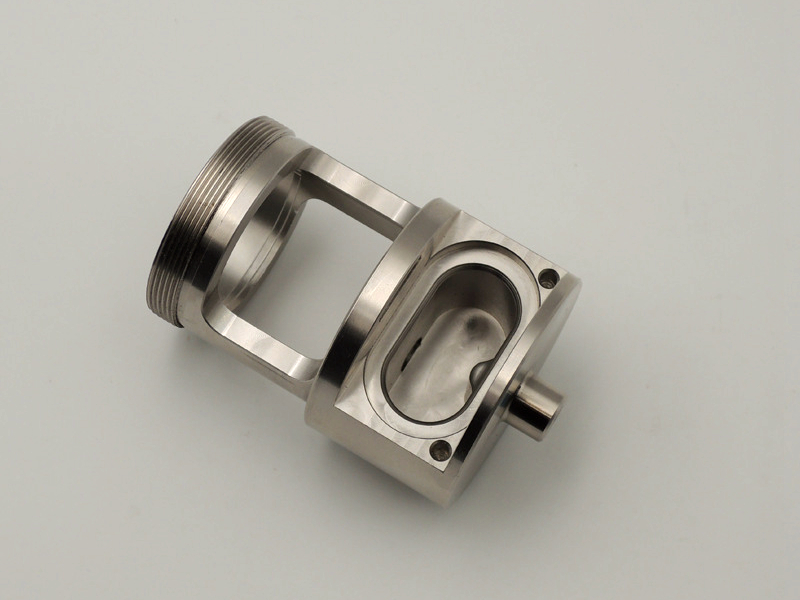
For high-integrity sealing bores, a stable process route normally matters more than one impressive machine number. Roughing may establish material balance, while CNC milling or CNC turning services can create the reference geometry before reaming, boring, interpolation, honing, or fine finishing. When the bore is deep, interrupted, crossed by another passage, or tied to multiple datum faces, finishing by CNC grinding services may be considered if the geometry and access allow it. Complex manifolds or valve blocks benefit from multi-axis machining service because fewer setups can reduce datum transfer error between sealing bores, ports, threads, and mounting faces.
For stainless grades with work hardening or toughness challenges, stable, low-vibration precision machining service helps control bore taper, chatter marks, tool push-off, and heat-related size drift. Process planning should define roughing allowance, finish tool engagement, coolant strategy, tool wear limits, deburring access, and inspection frequency. If a seal groove or cross-hole meets the bore, burr control becomes part of tolerance control because a raised burr can damage the seal during assembly even when the measured bore diameter is acceptable.
Material and surface finish considerations
Stainless grade and condition change cutting response, corrosion behavior, tool wear, and post-process movement, so the material callout must use the applicable product standard rather than a family name alone. General stainless steel machining may include hydraulic blocks and fittings made from stainless steel grades SUS304 when its corrosion resistance and mechanical properties fit the fluid and load. Chloride-bearing service may justify SUS316L after a corrosion-compatibility review. Higher strength or hardness can point to heat-treated Stainless Steel SUS630 (17-4PH), whereas Stainless Steel SUS904L, is selected for severe corrosion exposure rather than as a high-strength substitute. The RFQ should identify grade, governing standard, heat-treatment condition, material certificate, hydraulic fluid, temperature, and pressure.
Leak-tight hydraulic bores need size, form, texture, and edge condition to work together. Elastomeric seals may accept a different roughness window than sliding spools or metal-to-metal seats, so the Ra limit and lay direction should follow the seal or valve design for the stated service. Processes such as electropolishing for precision parts can reduce surface peaks and improve cleanability, but removed material and edge rounding belong in the final-dimension plan. A stainless steel passivation service removes surface contamination and supports corrosion resistance; passivation is not a correction for bore size, form, or texture.
Application-driven tolerance examples
In Aerospace and Aviation hydraulic actuators, bore tolerance planning usually prioritizes leakage control, fatigue risk, traceability, and stable geometry across temperature cycles. In Automotive brake, steering, or transmission components, the key challenge is often repeatability across production volume, seal assembly, and cost-controlled inspection. Heavy-duty manifolds and valves for Industrial Equipment may use more robust bore fits when contamination, vibration, field service, and durability matter more than minimum clearance.
In practice, the achievable bore tolerance is the result of material grade, bore geometry, seal concept, machining route, finishing method, deburring access, and inspection strategy. Buyers should send the 2D drawing, 3D model, seal specification, pressure rating, mating part data, surface finish note, burr requirement, and expected inspection method with the RFQ. If leakage, spool movement, or seal wear is critical, request a first-article inspection plan that reports bore size, roundness or cylindricity where required, surface roughness, and any post-treatment dimensional change before production release. For repeat orders, ask how the supplier will control tool wear, gauge correlation, cleaning after deburring, and sampling frequency. A bore that passes the first sample can still drift during production if cutter wear, heat, or post-treatment removal is not monitored. The approval package should define which measuring device is used, where the bore is measured, how temperature is controlled, and what action is taken when roundness or taper trends toward the limit.
Final acceptance should define the bore as a sealing function, not only as a diameter. For O-ring grooves, lead-in chamfers, intersecting ports, and threaded connections near the bore, edge break and burr removal can be as important as H7 or H8 size. The RFQ should name the preferred gauge method, such as air gauge, bore gauge, or CMM probing, because each method reads form error and surface condition differently on small or deep hydraulic bores.