Why Are Corrosion Resistance and Pressure Integrity Critical for Oil and Gas Machined Parts?
<p><a target="_blank" href="https://www.newaymachining.com/services/cnc-machining/faq-why-are-corrosion-resistance-and-pressure-integrity-critical-for-oil-and-gas-machined-parts"><img src="https://www.newaymachining.com/storage/attachments/2026/04/24/Why Are Corrosion Resistance and Pressure Integrity Critical for Oil and Gas Machined Parts.webp" alt="Corrosion resistance and pressure integrity in oil and gas parts" width="800" height="600" loading="lazy"></a></p>
<h2 id="why-are-corrosion-resistance-and-pressure-integrity-critical-for-oil-and-gas-machined-parts?">Why Are Corrosion Resistance and Pressure Integrity Critical for Oil and Gas Machined Parts?</h2>
<p>Corrosion resistance prevents damaging wall loss, pits, cracking, and seal-surface attack, while pressure integrity keeps a component leak-tight throughout its approved operating envelope. Both are critical for <a target="_blank" href="https://www.newaymachining.com/solutions/oil-and-gas">oil and gas</a> parts because localized damage can create a leak path before general surface loss looks severe. Material selection, pressure design, machining, finishing, inspection, and functional testing must address the same service conditions. Buyers should identify the pressure boundary, fluid phases, H2S/CO2/chloride exposure, temperature, cyclic load, critical interfaces, and acceptance evidence in the RFQ.</p>
<p><a target="_blank" href="https://www.newaymachining.com/services/cnc-machining">CNC machining</a> controls the manufactured geometry of bores, seats, threads, grooves, faces, and wall transitions; it does not create a pressure rating by itself. Surface processes also have limited roles. <a target="_blank" href="https://www.newaymachining.com/knowledge-hub/how-passivation-enhances-the-corrosion-resistance-of-cnc-machining-components">Passivation</a> supports the passive condition of suitable stainless steel after proper cleaning, while <a target="_blank" href="https://www.newaymachining.com/knowledge-hub/electropolishing-a-process-that-improves-cnc-part-smoothness-and-durability">electropolishing</a> removes a controlled surface layer and can reduce micro-roughness. Neither process repairs an incompatible alloy, an undersized pressure wall, a crack, or an incorrect seal geometry.</p>
<h3 id="1.-why-these-two-properties-matter-more-in-oil-and-gas-than-in-many-other-industries">1. Why These Two Properties Matter More in Oil and Gas Than in Many Other Industries</h3>
<p>Corrosion resistance and pressure integrity receive high scrutiny when failure can release hazardous media, stop production, damage adjacent equipment, or prevent safe isolation. The consequence depends on the component and service, not the industry label alone. A cosmetic bracket, pressure connector, valve seat, and instrument housing require different controls even on the same installation.</p>
<p>Pressure integrity is a system property that combines approved design, material condition, manufacturing quality, assembly, and specified testing. Corrosion resistance is also conditional on chemistry, temperature, stress, crevices, flow, deposits, and surface state. A new part can meet dimensions yet remain unsuitable for service if either evidence chain is incomplete.</p>
<div class="i-typography-table-responsive"><table><tbody><tr><th colspan="1" rowspan="1"><p>Critical Requirement</p></th><th colspan="1" rowspan="1"><p>Why It Matters in Oil and Gas</p></th><th colspan="1" rowspan="1"><p>Main Risk If Weak</p></th></tr><tr><td colspan="1" rowspan="1"><p>Corrosion resistance</p></td><td colspan="1" rowspan="1"><p>Maintains wall, threads, seal lands, and material condition in the defined environment</p></td><td colspan="1" rowspan="1"><p>Pitting, cracking, wall loss, seizure, contamination, or loss of seal contact</p></td></tr><tr><td colspan="1" rowspan="1"><p>Pressure integrity</p></td><td colspan="1" rowspan="1"><p>Maintains the qualified boundary, joints, and seals under specified loads</p></td><td colspan="1" rowspan="1"><p>Leakage, unstable operation, joint damage, rupture, or loss of isolation</p></td></tr></tbody></table></div>
<h3 id="2.-what-happens-when-leakage-or-seal-failure-occurs-in-machined-oil-and-gas-parts?">2. What Happens When Leakage or Seal Failure Occurs in Machined Oil and Gas Parts?</h3>
<p>Leakage begins when a continuous path forms across a pressure boundary or sealing interface. Causes include damaged gasket lands, incorrect groove geometry, thread or shoulder error, porosity, cracks, distortion, contamination, corrosion pits, coating buildup, or loss of assembly preload. The same visible leak can therefore require very different corrective action.</p>
<p>A leak test checks leakage under the stated medium, pressure, temperature, duration, assembly, and acceptance rule. A proof or pressure test addresses another requirement defined by the governing design or product specification. Neither test identifies every crack, corrosion mechanism, dimensional error, or future failure mode. Buyers should require the applicable test procedure, calibrated equipment, traceable result, and reaction to failure.</p>
<h3 id="3.-wear-also-threatens-pressure-integrity-because-damaged-functional-surfaces-stop-sealing-correctly">3. Wear Also Threatens Pressure Integrity Because Damaged Functional Surfaces Stop Sealing Correctly</h3>
<p>Wear threatens pressure integrity when it changes clearance, contact stress, alignment, or seal geometry. Valve trim can erode under particle-laden flow; threaded joints can fret; stems can gall; sleeves can lose support; and seal lands can score. Corrosion can accelerate these mechanisms by weakening the surface or creating abrasive debris.</p>
<p>Wear control needs the material pair, hardness relationship, surface condition, lubrication, motion, load, temperature, contaminants, and expected cycle or exposure profile. Inspection should target the resulting failure mode. Dimensional trend, surface examination, hardness, debris monitoring, or functional leakage may be relevant, but one final measurement cannot describe a progressive wear system.</p>
<h3 id="4.-corrosion-resistance-is-not-only-about-material-choice">4. Corrosion Resistance Is Not Only About Material Choice</h3>
<p>Corrosion resistance starts with a qualified material condition but also depends on product form, heat treatment, weld state, cold work, residual stress, contamination, crevices, deposits, and finish. Heat tint or embedded iron can damage stainless performance. A sharp transition can concentrate stress, while a rough or damaged seal path can retain fluid and disrupt contact.</p>
<p>NACE MR0175/ISO 15156 applies to metallic materials in H2S-containing oil and gas production environments within its defined scope. It does not establish universal resistance to every corrosive medium. The purchase specification should identify the applicable standard part, material condition, hardness, environmental limits, fabrication restrictions, cleaning, final surface state, and records needed for acceptance.</p>
<h3 id="5.-pressure-integrity-depends-directly-on-machining-precision">5. Pressure Integrity Depends Directly on Machining Precision</h3>
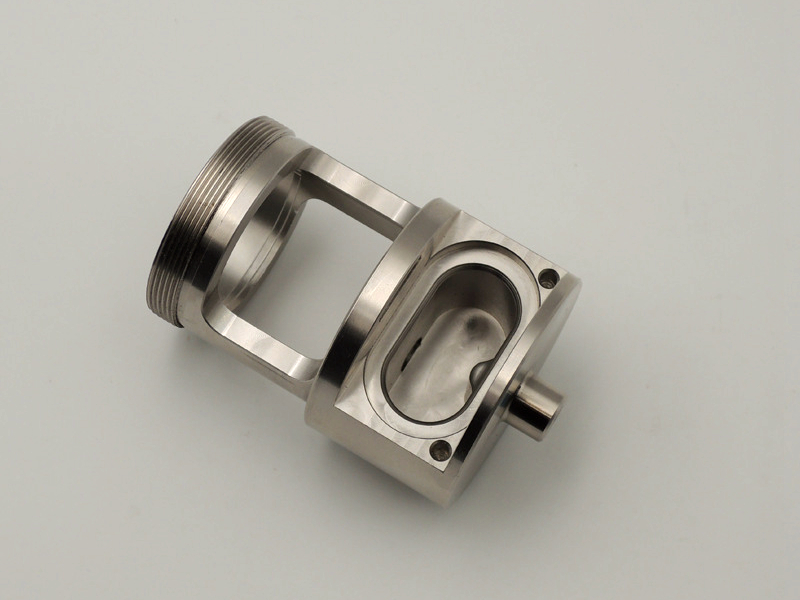
<p>Machining precision supports pressure integrity by producing the approved pressure-wall and sealing geometry, but it is only one part of the evidence. Critical dimensions may include minimum wall, seat position, seal-groove profile, thread form, shoulder location, flange-face relationship, and intersecting-bore alignment. The drawing must define datums and the final manufacturing state for those features.</p>
<p>Cylindrical connectors and valve components often use <a target="_blank" href="https://www.newaymachining.com/services/cnc-turning">CNC turning</a> for diameters, shoulders, faces, bores, and threads. Turning accuracy does not substitute for material qualification, defect control, assembly, or testing. A conforming diameter can coexist with a subsurface discontinuity, unsuitable hardness, damaged coating, or incorrect pressure design.</p>
<div class="i-typography-table-responsive"><table><tbody><tr><th colspan="1" rowspan="1"><p>Critical Machined Feature</p></th><th colspan="1" rowspan="1"><p>Why It Affects Reliability</p></th><th colspan="1" rowspan="1"><p>Failure Risk If Poorly Controlled</p></th></tr><tr><td colspan="1" rowspan="1"><p>Sealing face</p></td><td colspan="1" rowspan="1"><p>Controls contact, gasket support, and the continuous leakage path</p></td><td colspan="1" rowspan="1"><p>Leakage, seal cutting, uneven compression, or coating damage</p></td></tr><tr><td colspan="1" rowspan="1"><p>Bore and seat geometry</p></td><td colspan="1" rowspan="1"><p>Controls alignment, travel, clearance, and uniform seat contact</p></td><td colspan="1" rowspan="1"><p>Sticking, poor shutoff, localized wear, or unstable flow</p></td></tr><tr><td colspan="1" rowspan="1"><p>Thread integrity</p></td><td colspan="1" rowspan="1"><p>Controls engagement, shoulder position, preload, and connection alignment</p></td><td colspan="1" rowspan="1"><p>Assembly damage, leak path, loosening, or local overload</p></td></tr><tr><td colspan="1" rowspan="1"><p>Pressure wall and transitions</p></td><td colspan="1" rowspan="1"><p>Maintains approved section and avoids unintended stress concentration</p></td><td colspan="1" rowspan="1"><p>Insufficient margin, distortion, crack initiation, or invalid test interpretation</p></td></tr></tbody></table></div>
<h3 id="6.-surface-treatment-often-decides-whether-a-good-machined-part-keeps-performing-in-service">6. Surface Treatment Often Decides Whether a Good Machined Part Keeps Performing in Service</h3>
<p>Surface treatment helps only when it matches the substrate, failure mode, geometry, and service. For suitable stainless steel, <a target="_blank" href="https://www.newaymachining.com/knowledge-hub/how-passivation-enhances-the-corrosion-resistance-of-cnc-machining-components">passivation</a> is a cleaning and chemical-treatment route that supports the passive surface; it is not a dimensional coating. <a target="_blank" href="https://www.newaymachining.com/knowledge-hub/electropolishing-a-process-that-improves-cnc-part-smoothness-and-durability">Electropolishing</a> changes dimensions by removing material, so edge, thread, seal, and final-size requirements need process allowance and post-process inspection.</p>
<p>For steels, <a target="_blank" href="https://www.newaymachining.com/knowledge-hub/phosphating-a-key-to-enhancing-the-durability-of-cnc-machined-parts">phosphating</a> may support paint adhesion, lubricant retention, or limited corrosion control within a coating system. <a target="_blank" href="https://www.newaymachining.com/knowledge-hub/chrome-plating-for-cnc-parts-shiny-durable-and-corrosion-resistant">Chrome plating</a> needs thickness, adhesion, crack, grinding, and hydrogen-embrittlement controls where applicable. <a target="_blank" href="https://www.newaymachining.com/knowledge-hub/nitriding-the-secret-to-harder-more-wear-resistant-cnc-machining-components">Nitriding</a> primarily changes surface hardness and wear behavior; it is not a universal corrosion barrier. Final acceptance must address the actual process and functional surface.</p>
<h3 id="7.-typical-failure-risks-show-why-corrosion-and-pressure-must-be-managed-together">7. Typical Failure Risks Show Why Corrosion and Pressure Must Be Managed Together</h3>
<p>Corrosion and pressure interact through geometry, stress, and time. A pit can raise local stress; wall loss can reduce remaining section; hydrogen-related damage can lower cracking resistance; deposits can create crevices; erosion can strip protective films; and a damaged thread can concentrate load. Treating each mechanism in isolation can miss the combined failure path.</p>
<p>A defensible plan identifies the dominant mechanisms and connects prevention with detection. Material and environmental limits prevent some damage; machining and finishing protect critical geometry; NDE searches for specified discontinuities; dimensional inspection verifies features; and leak or pressure tests check defined functional conditions. The reaction plan should address containment, engineering disposition, rework limits, and revalidation after a process change.</p>
<h3 id="8.-materials,-machining,-and-surface-treatment-must-work-as-one-reliability-system">8. Materials, Machining, and Surface Treatment Must Work as One Reliability System</h3>
<p>Reliable pressure parts require one controlled chain from design input to final release. Contract review confirms service and standards. Material control verifies grade, product form, heat treatment, hardness, and traceability. Machining preserves wall and datum relationships. Special processes protect or modify surfaces. Inspection and testing then verify the characteristics assigned to each method.</p>
<p>A weak link cannot be repaired by adding unrelated paperwork. Positive material identification does not prove heat treatment; CMM results do not prove freedom from cracks; NDE does not prove dimensional conformance; and a pressure test does not establish future corrosion life. Buyers should request a concise evidence matrix that assigns each risk to an appropriate control and record.</p>
<div class="i-typography-table-responsive"><table><tbody><tr><th colspan="1" rowspan="1"><p>Reliability Factor</p></th><th colspan="1" rowspan="1"><p>Main Contribution</p></th><th colspan="1" rowspan="1"><p>What Happens If It Is Weak</p></th></tr><tr><td colspan="1" rowspan="1"><p>Material and environmental qualification</p></td><td colspan="1" rowspan="1"><p>Defines strength, toughness, hardness, and corrosion limits</p></td><td colspan="1" rowspan="1"><p>Cracking, wall loss, wrong condition, or invalid service assumption</p></td></tr><tr><td colspan="1" rowspan="1"><p>Machining and datum control</p></td><td colspan="1" rowspan="1"><p>Creates pressure-wall, joint, seal, thread, and alignment geometry</p></td><td colspan="1" rowspan="1"><p>Leak path, stress concentration, poor fit, or unstable operation</p></td></tr><tr><td colspan="1" rowspan="1"><p>Finishing, inspection, and functional test</p></td><td colspan="1" rowspan="1"><p>Protects the final state and supplies risk-specific acceptance evidence</p></td><td colspan="1" rowspan="1"><p>Hidden damage, false acceptance, premature degradation, or uncontrolled rework</p></td></tr></tbody></table></div>
<h3 id="9.-summary">9. Summary</h3>
<p>Corrosion resistance and pressure integrity are critical for <a target="_blank" href="https://www.newaymachining.com/solutions/oil-and-gas">oil and gas</a> parts because pits, cracks, wall loss, wear, thread damage, and seal-surface deterioration can create a pressure leak or loss of isolation. The two requirements are linked through material condition, service environment, stress, geometry, surface state, assembly, and time. No single inspection or finish proves the complete system.</p>
<p>RFQs for pressure-related <a target="_blank" href="https://www.newaymachining.com/services/cnc-machining">CNC machined parts</a> should define service media, environmental limits, design code or product specification, material and final condition, critical pressure and sealing features, corrosion control, special processes such as <a target="_blank" href="https://www.newaymachining.com/knowledge-hub/how-passivation-enhances-the-corrosion-resistance-of-cnc-machining-components">passivation</a> or <a target="_blank" href="https://www.newaymachining.com/knowledge-hub/electropolishing-a-process-that-improves-cnc-part-smoothness-and-durability">electropolishing</a>, NDE scope, dimensional plan, test procedure, traceability, and required records. That package lets the supplier connect each failure risk to a verifiable control without treating machining precision as a pressure-rating guarantee.</p>