How Should Fixture Cost Be Evaluated for Small Production Lots?
How Should Fixture Cost Be Evaluated for Small Production Lots?
Fixture cost for a small production lot should include design, build, tryout, reload time, storage, maintenance, replacement-contact qualification, and the evidence needed to prove the locating condition. Comparing only the purchase price can select a fixture that is cheap to build but expensive to verify or difficult to recover after a pause. The buyer should compare the full control burden over the expected quantity window and state which costs are one-time, recurring, or triggered by a change.
Map the Contact and Datum Chain
Start with the functional interfaces on the controlled drawing. Identify which surfaces locate, which constrain rotation, which provide support, and which must remain free from clamp marks. Link each contact to the datum scheme and to the inspection alignment. A fixture can hold a part securely while still allowing a positional or angular error if the contact chain is not documented. The setup record should identify contact order, support state, clamp direction, and the check that confirms seating.
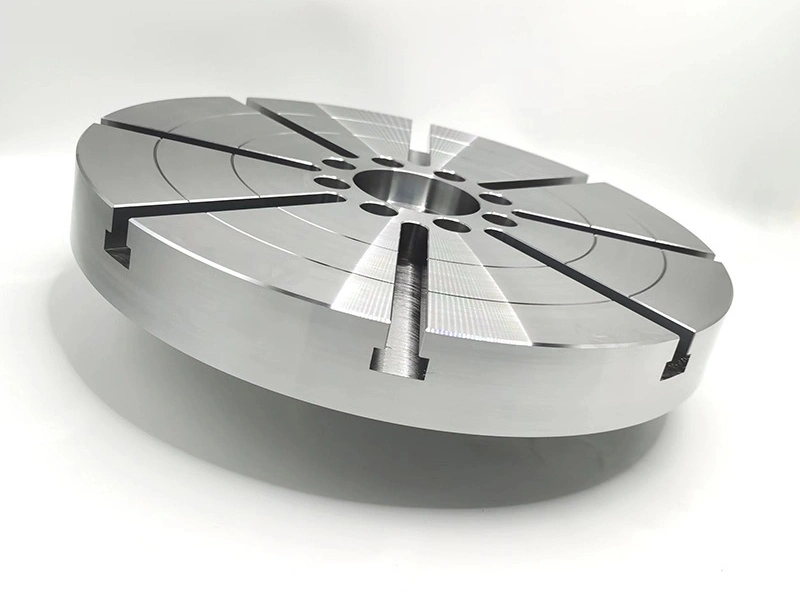
The pictured silver assembly has a base, an upright plate, a rounded raised pad, screws, and side hardware. Those visible details can prompt questions about access and support, but they do not prove the intended load, material, tolerance, or fixture method. Ask whether the base or upright plate is the locating reference, whether the pad is functional, and whether side hardware changes the measured state. Keep the answer in controlled engineering documents.
Price One-Time Work Separately
One-time work may include fixture design, construction, programming, tryout, first-piece qualification, and a setup record. Recurring work may include reload, cleaning, inspection, maintenance, and storage. A replacement locator, soft jaw, or contact insert can create a requalification event. Request a quote that identifies each category instead of placing all effort in a single unit price. This lets the buyer compare a dedicated fixture with modular jaws or probing without treating the lowest first invoice as the lowest total cost.
When demand is uncertain, model at least a pilot quantity, a repeat lot, and a higher forecast case. Include split-lot reloads, material replenishment, and a long pause. A fixture that is economical for one uninterrupted run may be poor for several small releases. Ask which assumptions change the recommendation and what evidence supports the threshold.
Evaluate Maintenance and Replacement
Maintenance should name the surfaces that collect chips, wear, or lose protection. Define a cleaning method, inspection frequency, and stop condition. If a locator is replaced, record the old and new identifiers, reason, contact geometry, qualification result, and first lot released afterward. A visually similar replacement is not automatically equivalent. If clamp direction or support changes, evaluate affected CTQs rather than checking only a convenient overall dimension.
Storage also affects cost. Label the fixture with revision and configuration, protect contact surfaces, and retain its maintenance history. If two part families share a nest, use positive configuration control to prevent a setup intended for one revision from being used for another. The evidence owner should be clear before the fixture is returned to storage.
Compare Options by Evidence
| Option | Potential advantage | Question that controls the choice |
|---|---|---|
| Dedicated fixture | Stable configuration for repeated geometry | How are storage and maintenance recovered? |
| Modular jaws | Lower initial commitment for changing demand | How is each configuration identified and qualified? |
| Probe-assisted setup | Additional location feedback | Which datum and state does probing verify? |
| Manual arrangement | Low tooling investment for a short run | How are seating and operator variation controlled? |
Do not convert the table into a universal cycle-time claim. Ask the supplier for a setup sketch, datum transfer explanation, access limits, and reaction plan. Evidence that a fixture exists is weaker than evidence that the fixture controls the characteristics that matter for this part.
Connect Fixture Economics to the RFQ
Provide drawing revision, model, quantity range, material condition, datums, CTQs, access constraints, support state, inspection requirements, and packaging assumptions. Ask bidders to separate fixture, programming, qualification, recurring conversion, maintenance, and reinspection costs. Require notification for fixture, locator, tool, program, material, processor, or inspection-method changes. Ask what event requires a new first-piece review.
Include the cost of proving the setup, not only of holding the part. A CNC machining route review can frame the operation sequence, while a quality inspection planning reference can frame record ownership. Neither page replaces the part-specific datum and acceptance requirements.
Buyer Action
Request a cost breakdown and a configuration-controlled fixture response. Approve the locating strategy before production, retain the setup and maintenance records with the purchase revision, and define the requalification trigger. Choose the option whose evidence remains defensible across the expected lot pattern, not simply the option with the smallest tooling line.