Which Material-State Details Belong in a Custom Precision RFQ?
Which Material-State Details Belong in a Custom Precision RFQ?
A custom precision RFQ should state the material grade or family, temper or heat-treatment condition, stock form, certification requirement, permitted substitutions, rough-stock envelope, and every state change that can affect acceptance. It should also identify which dimensions are checked before and after heat treatment, coating, anodizing, painting, or cleaning. The buyer's key action is to connect material identity and condition to the drawing revision, lot record, process route, and final inspection state. A photograph or surface appearance cannot establish alloy, hardness, residual stress, or coating thickness.
State the Material Identity
Use the designation controlled by the drawing and include the temper, grade, or heat-treatment state when it affects strength, machinability, or stability. State whether a certificate, heat number, lot number, or other traceability record is required. If an equivalent grade is acceptable, define the approval path and the properties that must be compared. “Aluminum,” “stainless,” or “tool steel” alone may be insufficient for a precision decision.
The visible color of a machined component is not a material test. Similar finishes can occur on different alloys or after different processes. Require the supplier to preserve the material record with the part or lot identifier so receiving can distinguish identity evidence from finished geometry evidence.
Define Stock and Allowance
List stock form, rough size, straightness or flatness expectations where relevant, and the allowance needed to clean datum and functional surfaces. Allowance depends on raw condition, workholding, expected distortion, heat treatment, access, and the remaining tolerance. Excess stock can increase cutting heat and cycle time; insufficient stock can leave a face below size after cleanup.
Ask the supplier to show where stock is reserved and where it is consumed. If a secondary process removes material, identify the final-state measurement. A quote based only on finished dimensions can hide the stock and sequence assumptions that control actual cost and stability.
Capture Heat and Process State Changes
Identify any stress relief, quench, aging, heat treatment, anodizing, plating, painting, passivation, or cleaning step. State whether the step is mandatory, optional, or supplier-selected. For each change, list affected features, masking or protection needs, dimensional growth or removal concerns, and the inspection required afterward. A pre-process result cannot silently represent the final condition when an outside process changes a fit.
Define storage and measurement conditions when temperature or moisture can influence the result. If the part is measured at a controlled temperature, record that condition with the instrument and datum frame. Do not use a generic temperature statement to hide an acceptance rule that has not been specified.
Link Material to the Machining Route
Material and condition influence tool selection, chip formation, burr behavior, cutting heat, support needs, and surface response. Ask the supplier to identify route assumptions without turning them into unsupported capability guarantees. A stainless route may need attention to work hardening and heat; a soft polymer route may need support and temperature control; a hardened condition may need a different finishing operation.
Where the route changes after a material substitution, require a documented review of affected CTQs. The buyer should not accept an apparently equivalent material merely because it produces a similar visual finish. Identity, condition, and process evidence must remain connected.
Require Material and Final-Part Evidence
Request the material certificate or lot reference within its defined scope, then request finished-part measurements for CTQs. A certificate can support chemistry or condition claims; it cannot prove hole location, flatness, surface roughness, or assembly fit. If a coating or heat-treatment certificate is required, identify the processor, batch, specification, and relation to the part lot.
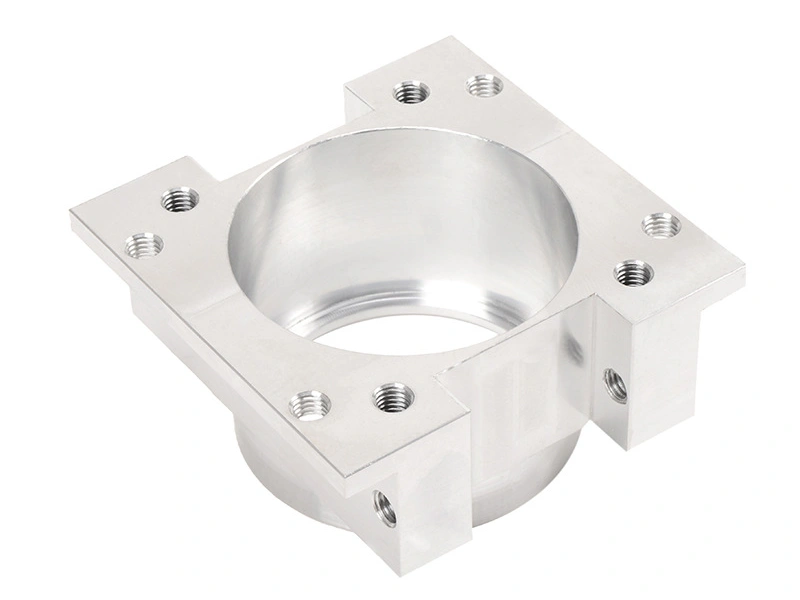
For a compact clamp assembly, clarify whether the base and blocks share material requirements and whether fasteners are included. The image shows geometry only. The drawing and RFQ should control grade, condition, coating, and acceptance state.
Make Material Assumptions Comparable
Ask every bidder to quote the same material designation, state, stock basis, certificate scope, outside processing, masking, final inspection, packaging, and freight assumptions. Separate one-time qualification from recurring material and process costs. Require explicit approval for substitution or state changes.
The best RFQ is not the longest list; it is the one that makes material identity, condition, acceptance state, and evidence unambiguous. Send the controlled revision, quantity forecast, CTQs, final-state requirements, and approval rules before comparing prices.
When the part is assembled with a clamp or support, specify whether contact surfaces receive a finish, remain masked, or are protected from contamination. State whether the material certificate covers the delivered component, the raw stock, or the complete lot, and identify any split between supplier and outside processor records. These details prevent a receiving team from treating a raw-material document as proof of final condition. They also let bidders price cleaning, masking, and reinspection consistently instead of hiding them in an allowance.