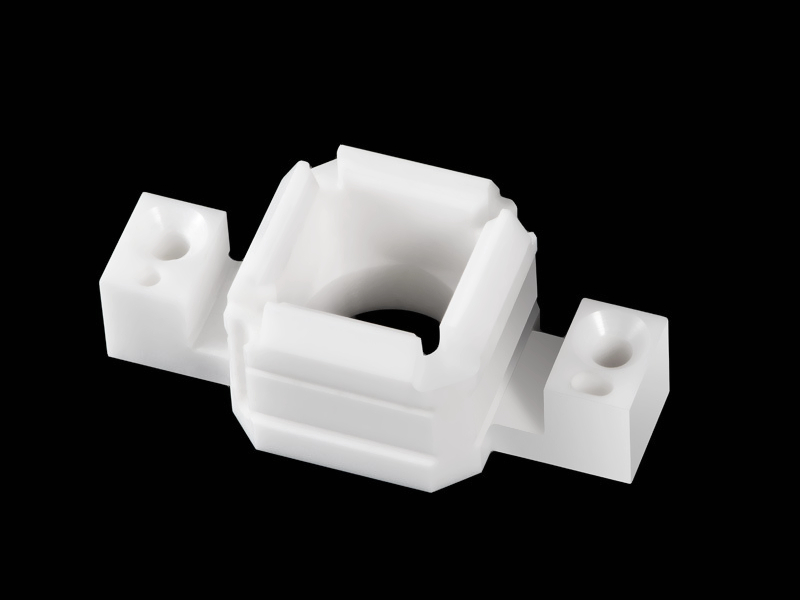
Ceramics
Material Introduction
Ceramics used in CNC machining are advanced engineering materials selected when the application requires extreme hardness, strong wear resistance, electrical insulation, thermal stability, chemical inertness, or dimensional reliability under harsh conditions. Compared with metals and plastics, ceramics are more brittle, but they can provide superior performance in environments involving high temperature, abrasion, corrosive media, or electrical isolation.
This material family includes Zirconia (ZrO2), Alumina (Al2O3), Silicon Nitride (Si3N4), Aluminum Nitride (AlN), Silicon Carbide (SiC), and Boron Nitride (BN). These ceramic materials are commonly used for precision industrial components, insulating parts, semiconductor fixtures, high-temperature structures, wear parts, cutting-related components, and chemically stable custom machined ceramic parts.
Material Family Table
Ceramic Category | Representative Grades |
|---|---|
Oxide Ceramics | |
Non-Oxide Structural Ceramics | |
Thermal / Electrical Functional Ceramics |
Selection Direction
Ceramic grade selection should be based on mechanical load, impact sensitivity, wear condition, thermal shock, electrical insulation requirement, thermal conductivity target, chemical exposure, and final dimensional tolerance. Because ceramic materials differ greatly in toughness, thermal behavior, and machinability, they should not be treated as interchangeable simply because they are all non-metallic hard materials.
For general insulating and wear-resistant applications, alumina is often the most practical starting point. For tougher precision components, zirconia and silicon nitride are frequently preferred. For heat dissipation with electrical insulation, aluminum nitride is a strong candidate. For severe abrasion and extreme hardness, silicon carbide may be more suitable. For high-temperature non-wetting and specialized thermal management environments, boron nitride should be evaluated more carefully.
Design Intent of Ceramics
Ceramics are selected in CNC machining when the component must survive conditions that are difficult for metals or plastics, such as abrasive wear, electrical insulation under heat, corrosive chemical exposure, thermal cycling, or long-term dimensional stability at elevated temperature. Their design intent often focuses on functional performance rather than ductility, because ceramics provide hardness and stability rather than metal-like toughness.
The design intent varies by ceramic type. Oxide ceramics such as alumina and zirconia are commonly selected for insulation, corrosion resistance, and wear parts. Non-oxide ceramics such as silicon nitride and silicon carbide are used where stronger thermal and structural performance is required. Functional ceramics such as aluminum nitride and boron nitride are selected where thermal management, electrical behavior, machinability in specialized forms, or high-temperature process compatibility become critical.
General Properties
Property | Typical Engineering Meaning |
|---|---|
Hardness | Extremely high compared with most metals and plastics |
Wear Resistance | Excellent in abrasive and sliding environments |
Electrical Insulation | Excellent in many oxide and nitride ceramic families |
Chemical Stability | Strong resistance to corrosion and many aggressive media |
Thermal Stability | Suitable for high-temperature and thermally demanding environments |
Brittleness | Critical design limitation requiring edge, impact, and fixture control |
Mechanical Behavior
Property | Engineering Relevance |
|---|---|
Toughness | Usually limited, but relatively better in zirconia and silicon nitride |
Compressive Strength | Generally very high and useful in loaded contact parts |
Thermal Shock Resistance | Important in heating and cooling cycles, especially for structural ceramics |
Dimensional Stability | Supports precision parts in severe environments |
Surface Integrity Sensitivity | Machining damage, microcracks, and chipping must be controlled carefully |
Machinability | More difficult than metals, highly dependent on ceramic type and supply condition |
Material Characteristics
Ceramic materials are characterized by high hardness, low ductility, and strong environmental stability. Alumina is widely used because it offers a practical balance of insulation, hardness, corrosion resistance, and cost. Zirconia provides better fracture toughness and is often selected when a ceramic part needs improved resistance to cracking. Silicon nitride offers strong thermal shock performance and mechanical reliability, while silicon carbide is preferred for extreme wear, hardness, and high-temperature service.
Aluminum nitride is valuable when the application needs both electrical insulation and high thermal conductivity. Boron nitride is often selected for specialized high-temperature, non-wetting, and thermally functional environments where conventional structural ceramics may not be ideal. Because each ceramic solves a different engineering problem, material choice should always follow the actual service requirement.
Manufacturing Process Performance
Ceramic components are commonly produced through CNC milling, CNC drilling, CNC boring, and CNC grinding. In many cases, grinding-based finishing is especially important because advanced ceramics are much harder and more brittle than common engineering metals.
Compared with metal machining, ceramic process performance depends more heavily on crack control, local stress reduction, edge protection, and careful stock removal strategy. Process planning should consider whether the ceramic is machined in green, bisque, or fully sintered condition, because the machining difficulty and achievable efficiency can differ significantly depending on the material state.
Applicable Post-processing
Ceramic parts may require edge refinement, surface finishing, precision grinding, cleaning, and dimensional verification depending on the part function. In many cases, the most important post-machining concern is not cosmetic finishing but protection of surface integrity so that microcracks, chips, and stress concentrators do not reduce the performance of the final component.
Where the application requires tighter control of fit, flatness, surface quality, or sealing behavior, final grinding and inspection are often critical. For demanding engineering applications, ceramic process validation should focus on geometric accuracy, crack-free surfaces, and long-term service reliability rather than appearance alone.
Common Applications
Ceramic materials are widely used in industrial equipment, power systems, electronics-related assemblies, automation systems, medical applications, and semiconductor-related environments. Typical applications include insulating spacers, nozzles, guides, rollers, wear plates, pump and valve details, thermal barriers, precision positioning parts, and chemically stable custom components.
In these applications, ceramics are often chosen because they provide performance that metals and plastics cannot easily match, especially in wear, insulation, heat, and chemical resistance. The exact ceramic grade should be selected according to whether the design prioritizes toughness, wear resistance, thermal conductivity, insulation, thermal shock behavior, or environmental stability.
When to Choose Ceramics
Choose ceramics when the application requires extreme hardness, long-term wear resistance, electrical insulation, corrosion resistance, thermal stability, or non-metallic dimensional reliability under demanding service conditions. Ceramics are especially suitable for insulating structures, abrasive-service components, thermal process hardware, and precision parts in severe chemical or high-temperature environments.
For general insulating and wear-resistant parts, alumina is often the best first option. For tougher precision ceramics, zirconia and silicon nitride should be evaluated. For thermally conductive insulating applications, aluminum nitride may be more appropriate. For severe wear and high-temperature conditions, silicon carbide may be the stronger route. The safest selection method is always to confirm load, impact risk, temperature, chemical environment, tolerance, and assembly condition before finalizing the ceramic grade.
Engineering Selection Note
Ceramics should be selected based on the actual functional requirement rather than the material family name alone. For RFQ evaluation, customers should provide the 2D drawing, 3D model, tolerance target, part size, operating temperature, mechanical load, impact risk, chemical exposure, electrical requirement, surface finish expectation, and whether the part will be used in static, sliding, sealing, or thermal service.
This allows NewayMachining to determine whether oxide ceramics, structural non-oxide ceramics, or thermal/electrical functional ceramics are the most appropriate material route for the project, and whether milling, drilling, boring, grinding, or another precision ceramic machining combination is best suited for the part.
Explore Related Blogs