What Prototype Evidence Belongs in a Production Handoff?
What Prototype Evidence Belongs in a Production Handoff?
A production handoff should include only prototype evidence that is tied to an approved revision, defined material and state, controlled fixture and route, measurable CTQs, valid inspection or functional tests, open actions, and an explicit transfer decision. A prototype report is not automatically a production qualification. The buyer should classify each observation as a released requirement, a process control, a design learning, or non-transferable evidence.
Classify What Transfers
Transfer a datum lesson when the production route preserves the same functional frame; transfer a fixture access lesson when the production setup uses the same contact logic; transfer a functional result only when material, geometry, mating hardware, load, and environment remain valid. A hand-polished surface, temporary shim, or exploratory tolerance should not become a production promise without approval.
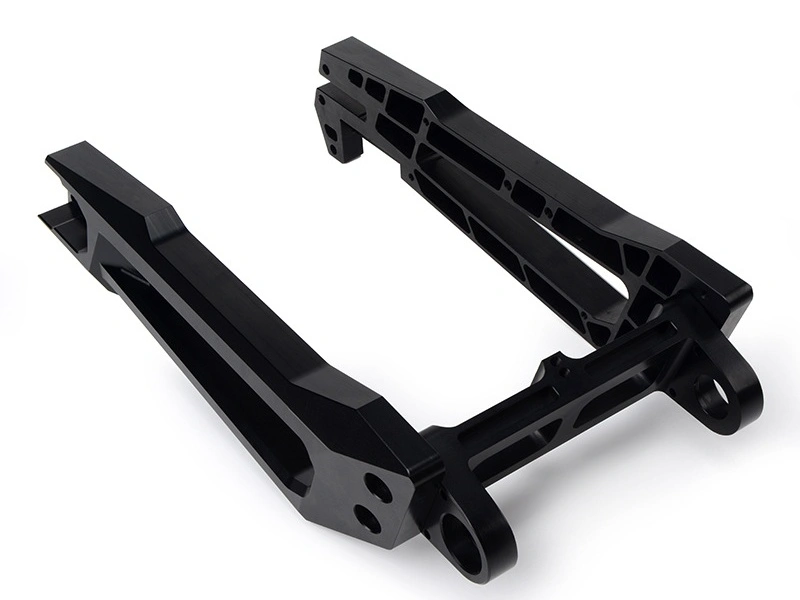
The link-arm photographs show recessed channels, a central circular area, and rounded ends from different views. They can support a visual geometry description, not material, load, tolerance, performance, or customer-case claims. The handoff should reference the controlled drawing and test record instead of treating the image as qualification evidence.
Include Core Records
Provide drawing and model revision, material designation and condition, certificate scope, process or route review, fixture configuration, tool or program reference, CTQ map, dimensional results, functional or assembly test, outside-process records, deviations, open actions, and approval. Identify units, samples, methods, states, instruments, units, and record versions. Preserve raw results and any rework or replacement history.
If a prototype used a substitute material or a nonproduction fixture, mark the limitation and define the validation required before release. If an inspection method changes, record equivalence or requalification. A dimensional report does not silently prove function; a functional test does not prove unmeasured geometry or future lot stability.
Define Production Gates
Set gates for revision approval, material confirmation, fixture readiness, first-piece inspection, functional evidence, outside-process certificates, packaging, and change notification. Assign an owner and decision rule to each gate. Hold when a result uses the wrong revision, state, or unit, or when a required record is missing. Document rework, replacement, deviation, or rejection with the responsible authority.
Use a Handoff Checklist
| Handoff item | Question | Boundary |
|---|---|---|
| Design intent | Which interfaces and CTQs are controlled? | Do not promote learning notes |
| Process | Which route, fixture, and tool are approved? | Recheck changed configuration |
| Evidence | Which dimensional and functional records are valid? | Keep method and state visible |
| Open actions | Who closes remaining risk? | Do not call an open item accepted |
The table makes transfer decisions auditable. A CNC prototyping workflow can organize learning, and a quality inspection plan can organize evidence ownership. The production drawing and approved route remain authoritative.
Write the Handoff Into the RFQ
Request the controlled drawing, material, CTQ, fixture, process, inspection, functional test, outside-process, packaging, deviation, retention, and approval records. Ask suppliers to separate prototype learning from production evidence and identify the event that reopens qualification. Require notification before material, fixture, tool, program, route, processor, inspection method, packaging, or ownership changes.
Ask for an anonymized handoff packet or index. A generic “production-ready” label is not evidence that the route, records, and open actions are complete. Compare the packet with the controlled revision before issuing a production order.
Buyer Action
Approve the transfer classification, evidence list, production gates, and open-action owners. Move to production only when the handoff records and the approved route describe the same configuration.
Include a clear “not transferred” list. It may contain temporary dimensions, hand finishing, substitute material results, exploratory fixtures, or test conditions that production will not reproduce. Naming exclusions is as important as naming transferred controls because it prevents a later reviewer from treating every prototype observation as a released requirement.
Define who accepts the transfer and who owns each remaining action. The handoff should state the production first-piece requirement, any material or process revalidation, the inspection frequency, and the event that reopens qualification. A production order should not rely on a prototype author's interpretation of what “ready” meant.
Include the storage location and retention period for raw data, not just the signed summary. If a later failure requires a root-cause review, the original test conditions and instrument output may matter more than the conclusion. Preserve the evidence at the same revision used for the transfer decision.