What Should a Precision Boring RFQ State About Stock and Fit?
What Should a Precision Boring RFQ State About Stock and Fit?
A precision boring RFQ should state the bore function, entry stock, material state, datum scheme, mating hardware, fit condition, access, inspection evidence, and change boundaries. A finished diameter without those inputs hides the main causes of an unusable bore: uneven stock, axis drift, distortion, incorrect assembly state, or a fit tested under different conditions. The buyer should make every comparison use the same technical scope before selecting on price or cycle time.
State the Bore and Fit Function
Identify whether the bore locates a bearing, guides a shaft, carries a seal, provides clearance, or forms a common axis after assembly. Name mating hardware, load, motion, temperature, lubricant, insertion method, and service state when they affect fit. Separate diameter, roundness, cylindricity, axis location, perpendicularity, surface condition, and edge requirements. A successful insertion with one sample does not prove every requirement.
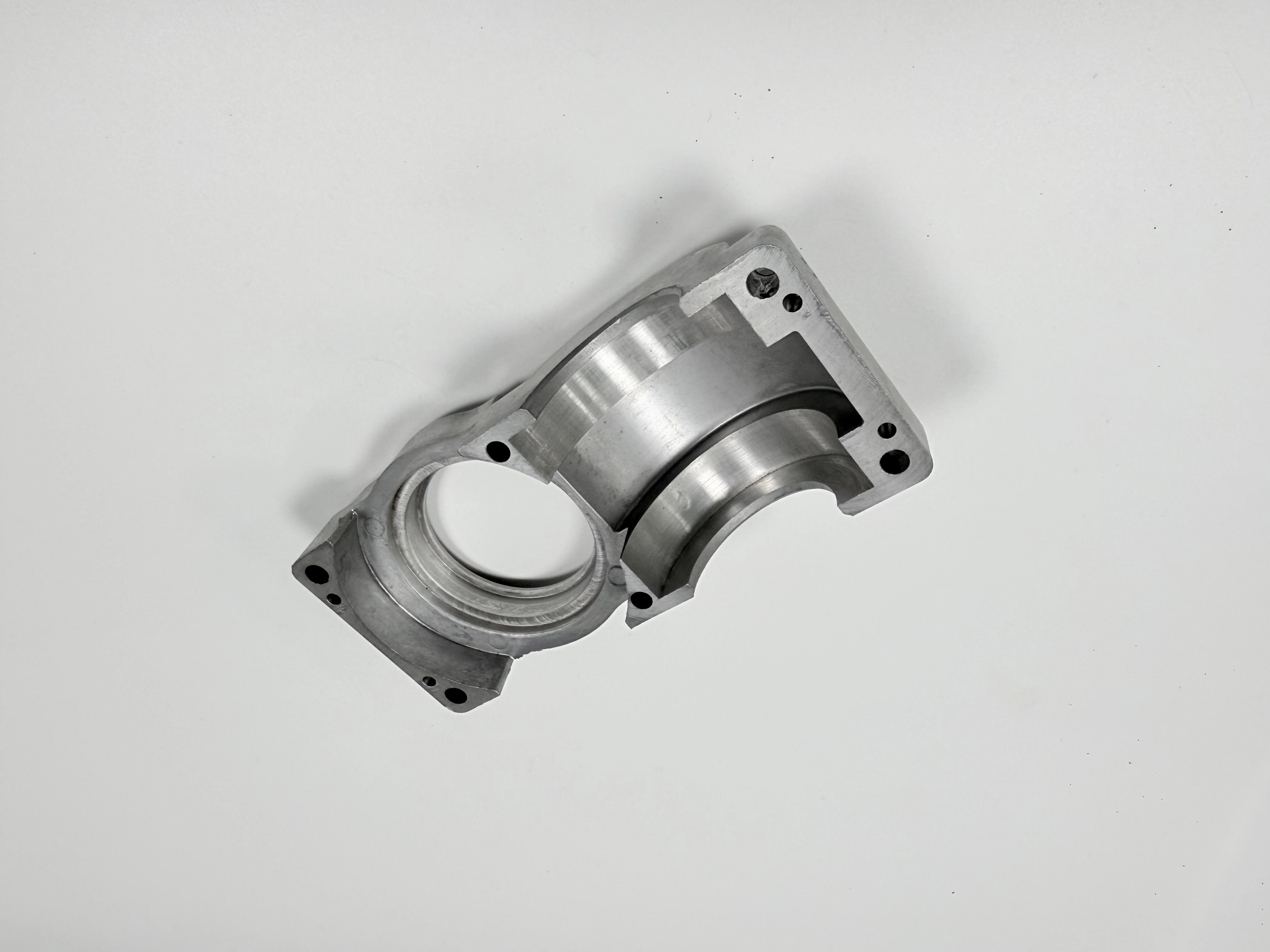
If the component is a split housing, state whether the fit is accepted on assembled halves, individual halves, or both. Include fastener, dowel, torque, joint seating, and orientation conditions. The visible housing images support only the presence of circular seats, mounting holes, and a split profile; they do not support a material, size, bearing, or load claim.
Define Entry Stock and Allowance
Provide rough-machined diameter, location, form, stock distribution, burr condition, and the operation that leaves the material. Set a feature-specific lower and upper entry window rather than one generic allowance. Too little stock can leave drill wander, casting skin, or a damaged layer; too much can increase deflection, heat, tool wear, and distortion. Ask the supplier how the entry window will be checked before boring.
State heat treatment, stress relief, welding, coating, aging, and stabilization before the finish operation. A material certificate supports identity within scope but does not predict distortion. If a coating or outside process follows boring, define before-and-after dimensions and the state that governs fit. Do not assume a finish allowance can absorb an unplanned process variation.
Write the Datum and Support Condition
Attach the primary, secondary, and tertiary datums, contact order, clamp direction, support points, and orientation sequence. Identify whether measurements are free, restrained, assembled, or paired. State fixture, locator, soft-jaw, shim, and cleaning requirements when they influence seating. A fixture datum selected for convenience can produce a repeatable but functionally shifted axis.
Require transfer checks after flipping, reorienting, replacing a locator, or changing a machine. Record witness features and how they relate to the functional axis. If the drawing datum is ambiguous, obtain an approved interpretation before quoting. A machine coordinate or nominal fixture stop is not a substitute for a controlled datum frame.
Define Fit Evidence
State how diameter, form, axis, and functional fit will be measured. Include sections, depths, angles, datum frame, instrument, calibration, temperature, restraint, units, sampling, and raw-data expectations. If a mating part or gauge is used, identify its revision, condition, load, lubricant, insertion speed, and acceptance. A plug gauge indicates a fit under its own condition; it does not prove axis or full cylindricity.
For a stepped or paired bore, specify the relationship between seats and the common axis. If a shoulder or deep region cannot be reached, state the alternate method or correlation. Define which results are every-unit and which are sampled. Hold the release when a critical region is unmeasured or a fit test is not representative of the delivered state.
Ask for Tool and Process Assumptions
Request tool reach, holder projection, insert or cutter assumption, coolant, chip evacuation, pass sequence, support, and process signals. Ask the supplier to identify what can be adjusted during the run and what requires approval. A “precision boring” label does not explain deflection control or interrupted-cut response. The supplier should state how first piece, tool change, fixture change, and entry-stock variation trigger rechecks.
Require notification before changing tool, holder, fixture, machine, program, coolant, material heat, inspection method, or outside processor. Ask how affected unit ranges are bounded and how original results are preserved. This makes a quote comparable on process control rather than only on the final diameter line.
Separate Cost and Delivery Scope
Break out programming, fixture, tooling, first-piece, inspection, rework review, outside processing, cleaning, packaging, and freight. State sample quantity, approval milestones, record format, and shipment condition. If matched housing halves or paired bores are involved, include identification and assembly checks in the scope. Do not compare a bare machining price with a quote that includes complete axis and fit evidence.
Ask for assumptions behind cycle time and capacity without treating them as a product guarantee. A supplier may quote a stable route only for one material heat, support state, and revision. Require a change notice when those conditions move. Keep price, timing, and evidence decisions separate so a short schedule does not hide an incomplete acceptance plan.
Review the Quote for Missing Boundaries
Look for omitted entry dimensions, unclear datums, unspecified assembly state, missing deep-bore access, absent inspection sections, and generic fit language. Ask who owns the drawing interpretation, transfer check, final measurement, and deviation approval. A strong response identifies limitations and proposes a controlled clarification. A vague promise should remain an open item, not be converted into an assumed capability.
Keep an answer log with revision, question, owner, and decision date. If the supplier's route changes after clarification, update the comparison rather than carrying forward the original price. Preserve redlined assumptions and approvals with the RFQ. The record should show why the selected scope is technically equivalent to the alternatives being compared.
Buyer Action
Issue the RFQ only after function, stock, datum, fit state, access, evidence, change control, cost, and delivery fields are explicit. Hold comparison when a quote omits entry condition, uses a convenient fixture datum, or treats a single fit result as complete proof. A comparable boring quote makes the bore decision reproducible before production begins.